
Digi Sunami

Digital Marketing vs Affiliate Marketing Key Differences Explained

Author: Shivam • Digital Marketing Strategist • 9 min read

Quick Answer: Digital marketing is a broad skill set covering all online channels — SEO, paid ads, social media, email, and content. Affiliate marketing is a specific performance-based business model where you earn commissions by promoting someone else’s products. Every affiliate marketer uses digital marketing, but not every digital marketer does affiliate marketing.

If you have been researching ways to grow a business or earn money online, you have likely come across both these terms used almost interchangeably. They are not the same thing, and confusing them leads to real problems — choosing the wrong career path, investing in the wrong skills, or building the wrong kind of business.

Let’s break down exactly what each one means, how they work, and which one actually makes sense for your situation.

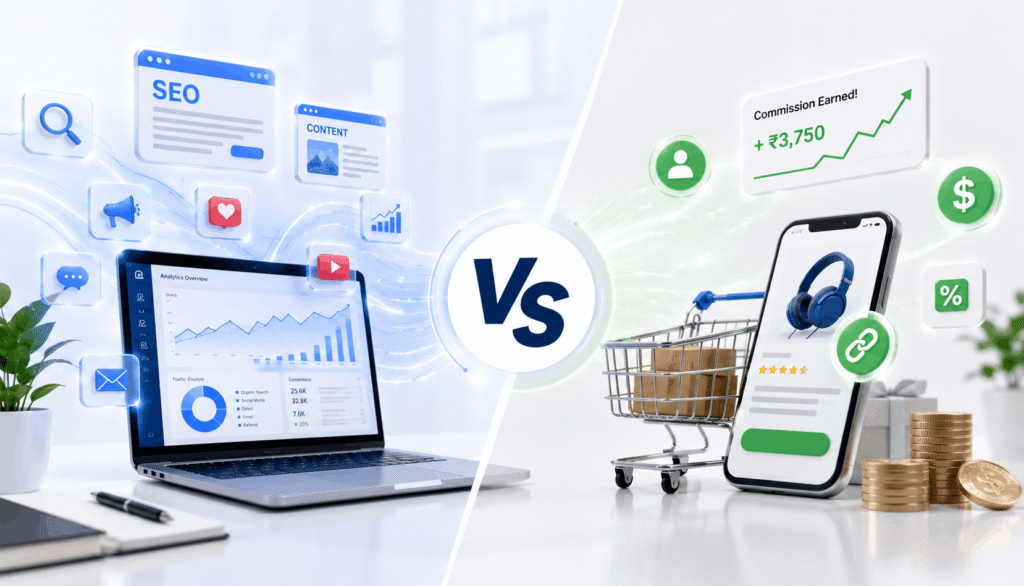
Digital Marketing vs Affiliate Marketing comparison showing SEO, content marketing, analytics, affiliate commissions, and online sales.

What Is Digital Marketing

Digital marketing refers to every promotional activity carried out through online channels to grow a brand, attract customers, and drive revenue. It is a broad umbrella that includes:

  • Search Engine Optimization (SEO) — improving organic visibility on Google and other search engines
  • Pay-Per-Click Advertising (PPC) — paid campaigns on Google Ads, Meta Ads, YouTube Ads
  • Social Media Marketing — building audience and engagement on Instagram, LinkedIn, Facebook, and X
  • Content Marketing — blogs, videos, guides, and educational content that attract and convert
  • Email Marketing — nurturing leads and customers through direct, personalized communication
  • Influencer Marketing — partnering with creators to reach their established audiences
  • Marketing Automation — using tools and AI to scale campaigns and personalize at volume

Digital marketing is typically practiced by in-house marketing teams, freelancers, and agencies on behalf of businesses. The goal is to build awareness, generate leads, and drive conversions across multiple touchpoints.

What Is Affiliate Marketing

Affiliate marketing is a performance-based revenue model. An affiliate promotes a third-party product or service using a unique tracked link. When someone makes a purchase, signs up, or completes another defined action through that link, the affiliate earns a commission.

The three parties involved:

  1. Merchant (Brand or Advertiser) — the company selling the product and running the affiliate program
  2. Affiliate (Publisher or Creator) — the individual or business promoting the product in exchange for commission
  3. Customer — the end user who clicks the link and completes the action

Common commission models:

  • Pay-Per-Sale (CPS) — most common, earn when a sale is made
  • Pay-Per-Lead (CPL) — earn when someone signs up or fills a form
  • Pay-Per-Click (CPC) — earn per click, less common now due to fraud risks

Affiliates typically use blogs, YouTube channels, email newsletters, social media, and niche websites to drive traffic to merchant pages.

Core Difference: Skill Set vs Business Model

This is the distinction most people miss.

Digital marketing is a skill set. You learn it, apply it on behalf of a business (your own or a client’s), and get paid through salary, retainers, or project fees.

Affiliate marketing is a business model. You build traffic and an audience using digital marketing skills, then monetize that audience by promoting other companies’ products for commission.

One is a way of working. The other is a way of earning.

Side-by-Side Comparison

FactorDigital MarketingAffiliate Marketing
DefinitionBroad set of online marketing strategiesPerformance-based commission model
ScopeWide — covers all online channelsNarrow — focused on promoting third-party products
Payment modelSalary, retainer, project feeCommission per sale, lead, or click
ControlFull control over brand and messagingLimited — you promote, merchant controls the product
Primary goalAwareness, engagement, and conversionsDrive measurable conversions for commission
Upfront investmentModerate to high (skills, tools, team)Low — no product creation required
ScalabilityScales via budget, channels, and teamScales via traffic volume and affiliate networks
Income timelineFaster — salary or client income quicklySlower — usually 6 to 18 months to meaningful income

How Affiliate Marketing Uses Digital Marketing

Here is where it gets important to understand clearly: affiliate marketing is not separate from digital marketing. It is a channel that runs inside the digital marketing ecosystem.

An affiliate uses SEO to rank blog posts that recommend products. They use content marketing to build an audience that trusts their recommendations. They use email marketing to nurture subscribers and promote affiliate offers. They use social media to drive traffic to their affiliate content.

Without digital marketing skills, affiliate marketing rarely generates meaningful income. The two are connected — affiliate marketing is simply one specific monetization strategy built on top of digital marketing execution.

Digital marketing and affiliate marketing workflow from content creation and SEO to affiliate sales and commission earnings.

Which One Is Right for You

Choose digital marketing if:

  • You want faster income through a job, freelancing, or agency work
  • You want full control over strategy and execution
  • You are building skills to offer as a service to businesses
  • You want a structured career path with clear progression

Choose affiliate marketing if:

  • You want to build a long-term, scalable passive income stream
  • You already have or are building an audience — a blog, YouTube channel, or newsletter
  • You are comfortable with slower initial income in exchange for long-term upside
  • You do not want to manage clients or deliver services

The honest reality for most beginners: digital marketing skills come first. Without the ability to drive traffic and build an audience, affiliate marketing income stays at zero regardless of how many programs you join. Learning digital marketing — specifically SEO and content marketing — is what makes affiliate income eventually possible.

If you are just starting out, our guide on how to earn money from digital marketing covers all six income paths including affiliate marketing, with realistic timelines for each.

Can You Do Both at the Same Time

Yes, and many people do. A common path looks like this:

  1. Learn digital marketing skills (SEO, content, paid ads)
  2. Get a job or freelance to generate immediate income
  3. Build a blog or YouTube channel on the side using those same skills
  4. Monetize that content through affiliate programs once traffic builds
  5. Gradually shift toward affiliate income as it grows

This path takes longer than either one alone, but it creates two separate income streams — active income from digital marketing work and passive income from affiliate commissions.

According to GeeksforGeeks’ detailed breakdown of affiliate and digital marketing, the most effective modern strategy is integration — using digital marketing for visibility and engagement while using affiliate marketing as a scalable, performance-driven conversion layer on top.

Common Mistakes People Make

Trying affiliate marketing without traffic. Joining ten affiliate programs before having any audience produces zero results. Traffic and trust come first.

Treating digital marketing as only a means to affiliate income. Many people learn digital marketing only to eventually do affiliate marketing, but miss the faster income opportunities available immediately through freelancing or agency work.

Promoting irrelevant products for higher commissions. Audience trust is harder to build than a commission rate. Promoting products that do not genuinely fit your content kills long-term affiliate income.

If you are building the skills that make both paths possible, our digital marketing career path guide covers how to develop those skills in the right order.

Final Thoughts

Digital marketing and affiliate marketing are not competing options. Digital marketing is the broader skill set that makes everything online work. Affiliate marketing is one specific way to monetize those skills through commission-based promotion.

Start with digital marketing skills. Build traffic and an audience. Then layer in affiliate income when the foundation is solid enough to support it.

Frequently Asked Questions

Is affiliate marketing part of digital marketing?

Yes. Affiliate marketing is a specific performance-based channel that operates within the broader digital marketing ecosystem. It uses digital marketing tools like SEO, content, and email to drive traffic, but focuses specifically on earning commissions from third-party products.

Which is better for beginners — digital marketing or affiliate marketing?

Digital marketing is usually the better starting point. It generates income faster through jobs or freelancing, and the skills learned — SEO, content, paid ads — are exactly what make affiliate marketing work later when you are ready to build passive income.

Can I do both digital marketing and affiliate marketing at the same time?

Yes. Many professionals do both — earning active income through digital marketing work while building affiliate income on the side through a blog or YouTube channel. It takes longer but creates two separate income streams over time.

How much can you earn from affiliate marketing in India?

Earnings vary enormously. Beginners with low traffic may earn very little in the first year. Established affiliates with significant organic traffic and trusted audiences can earn anywhere from ₹20,000 to several lakhs per month, depending on niche and commission rates.

Do I need a website to start affiliate marketing?

Not strictly, but having one makes affiliate marketing significantly more effective. A blog with SEO-optimized content creates long-term, compounding traffic that converts to affiliate income consistently, unlike social media posts which have short lifespans.

Want to understand how a results-focused agency builds and applies digital marketing strategy? Explore DigiSunami’s approach to online growth.

Keep Exploring with Digisunami

Scroll to Top