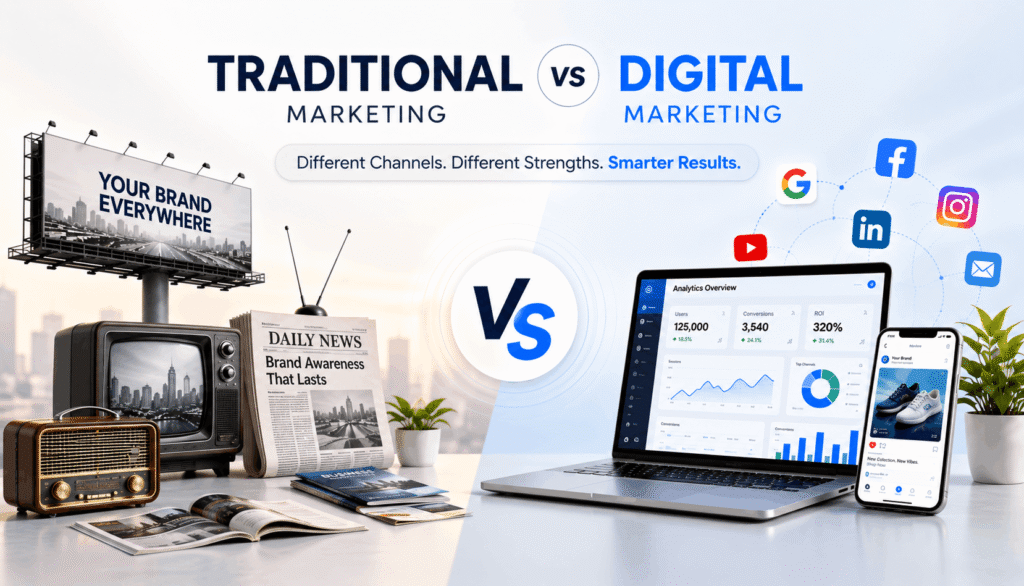
Traditional vs Digital Marketing
What Actually Works
Author: Shivam | 9 min read | July 17, 2026
Quick Answer: Traditional marketing uses offline channels like TV, print, radio, and billboards. Digital marketing uses online channels like search engines, social media, email, and websites. Digital marketing offers better targeting, measurable results, and lower entry costs — but traditional marketing still holds value for brand awareness at scale, especially for large businesses with mass-market products.Every few years someone declares that traditional marketing is dead. Every few years that declaration turns out to be wrong.
The more accurate picture is less dramatic: traditional and digital marketing have different strengths, different audiences, and different cost structures. Understanding what each does well — and what it doesn’t — is more useful than picking a side.
Here’s an honest comparison.
What Is Traditional Marketing
Traditional marketing covers any promotional activity that happens through offline channels. This includes:
- Print advertising — newspapers, magazines, brochures, flyers
- Broadcast advertising — TV commercials, radio spots
- Outdoor advertising — billboards, hoardings, transit ads
- Direct mail — physical letters, catalogues, postcards
- Events and sponsorships — trade shows, exhibitions, local events
- Telemarketing — outbound sales calls
These channels have been around for decades. They reach broad audiences without requiring internet access, which still matters in large parts of India where digital penetration varies significantly by region.
What Is Digital Marketing
Digital marketing covers all promotional activity that happens through online channels. This includes:
- SEO — getting discovered through organic search results
- Paid advertising — Google Ads, Meta Ads, YouTube Ads
- Social media marketing — building presence on Instagram, LinkedIn, Facebook
- Content marketing — blogs, videos, podcasts, guides
- Email marketing — nurturing leads and customers directly
- Affiliate and performance marketing — paying only for results
Unlike traditional marketing, digital marketing allows precise targeting, real-time measurement, and budget flexibility that wasn’t possible before the internet.
Side-by-Side Comparison
| Factor | Traditional Marketing | Digital Marketing |
|---|---|---|
| Reach | Mass, broad audience | Targeted, specific audience |
| Cost | High (especially TV, print) | Variable — starts very low |
| Measurability | Difficult, estimated | Precise, real-time data |
| Targeting | Limited (demographics only) | Highly specific (behaviour, interest, location) |
| Speed | Slow to launch and change | Fast — campaigns live in hours |
| Engagement | One-way communication | Two-way interaction possible |
| Lifespan | Fixed run duration | Evergreen content possible |
| Best for | Mass brand awareness | Targeted leads and conversions |
Where Traditional Marketing Still Wins
This is the part most digital-first content skips over, so let’s address it honestly.
Brand trust at scale. A full-page ad in a national newspaper or a prime-time TV spot still carries a credibility signal that most digital ads don’t match. For large brands selling to mass markets, this still matters.
Audiences with low digital presence. In India, a significant portion of the population — particularly in tier 2, tier 3 cities and rural areas — is more reachable through radio, local newspapers, or outdoor advertising than through Instagram or Google.
Physical product categories. FMCG brands, real estate developers, and automobile companies still generate significant business through print and broadcast because their buyers make decisions over longer timeframes and are influenced by repeated, broad exposure.
Events and local presence. A well-executed local event or exhibition builds relationships that no digital campaign easily replicates.
Where Digital Marketing Consistently Wins
Measurable ROI. Every rupee in a digital campaign can be tracked to a result. You know exactly which ad generated which lead. Traditional marketing rarely offers this clarity.
Budget flexibility. A small business can start a Google Ads campaign with ₹500. The equivalent reach through a newspaper ad or radio spot costs dramatically more with no targeting control.
Precise targeting. Showing an ad specifically to 28 to 40 year old business owners in Delhi NCR who have shown interest in marketing services is only possible digitally.
Two-way interaction. Social media and email marketing allow businesses to actually converse with their audience — answer questions, handle concerns, build relationships — in a way offline channels cannot.
Speed and adaptability. A digital campaign can be paused, changed, or scaled within hours based on performance data. A newspaper ad is fixed the moment it’s printed.
The Real Question: Which One Does Your Business Actually Need
The answer depends on three things: your budget, your audience, and your goals.
If you’re a small or medium business: Digital marketing almost always makes more sense to start with. Lower cost, better targeting, and measurable results mean your budget goes further and you can see what’s working faster. Our guide on affordable digital marketing services covers realistic entry points for businesses working with limited budgets.
If you’re a large business with a mass-market product: A hybrid approach — digital for targeting and conversion, traditional for scale and brand trust — often produces the best results. Neither channel alone does everything well.
If your audience is primarily offline: Ignoring traditional channels entirely in favour of digital because “everyone’s online now” is a mistake if your actual customers aren’t. Know your audience before committing to either approach.
Why Most Businesses Are Moving Toward Digital First
The shift isn’t because traditional marketing stopped working. It’s because digital marketing made the results of marketing spending visible for the first time.
When you can see exactly which campaign generated which customer, the pressure to justify every marketing rupee becomes much easier to handle. That visibility is what draws businesses toward digital channels — not a belief that billboards are useless.
According to IBEF’s India Digital Advertising Report, digital advertising spend in India has been growing consistently year over year, driven largely by small and mid-sized businesses discovering that digital channels let them compete with larger players on much smaller budgets.
If you’re figuring out where to start with digital marketing for your business, our breakdown of digital marketing costs for small businesses gives a realistic picture of what different channels actually cost.
Final Thoughts
Traditional vs digital marketing isn’t really a competition. They’re different tools with different strengths, and the smartest marketing decisions come from understanding both rather than dismissing one entirely.
For most small and medium businesses in India , digital marketing offers the better starting point — lower costs, better targeting, and measurable outcomes. But traditional channels aren’t irrelevant, especially for businesses reaching audiences where digital penetration is still limited.
Start where your audience actually is. That’s always the right answer.
Frequently Asked Questions
Yes, for specific contexts. Traditional marketing still works well for mass brand awareness, reaching audiences with low digital presence, and categories like FMCG and real estate where broad exposure drives decisions over time.
Digital marketing offers precise targeting, real-time measurability, lower entry costs, and two-way audience interaction — advantages traditional channels cannot match. For most small and medium businesses, this makes digital the more practical starting point.
Yes, but the cost per result is usually higher than digital marketing at small budgets. Local print ads, flyers, or community events can still work for very local businesses, but digital channels typically offer better ROI for most small business goals.
The main difference is measurability and targeting. Digital marketing lets you track exactly who saw your ad, what they did after, and what result it produced. Traditional marketing reaches broader audiences but offers limited data on campaign performance.
Large businesses with mass-market products often benefit from a hybrid approach. For most small and medium businesses, starting with digital marketing makes more sense due to lower costs and better targeting before adding traditional channels later.
Want to understand which marketing channels make sense for your specific business? Talk to DigiSunami for an honest, no-pressure conversation about your goals.
Keep Exploring with Digisunami
Agency Guide • India • July 20, 2026 How to Get Clients for Digital Marketing What Actually Works Author: Shivam • Digital
Marketing Guide • India • 2026 Traditional vs Digital Marketing What Actually Works Author: Shivam | 9 min read | July 17,
Career Guide • India • July 15, 2026 How Long Does It Take to Learn Digital Marketing? (Honest Answer) Author: Shivam •
Career Guide • India • 2026 Blogging in Digital Marketing: Why It Still Works and How to Do It Right Author: Shivam