Blogging in Digital Marketing: Why It Still Works and How to Do It Right
Author: Shivam | 9 min read | July 13, 2026
Quick Answer: Blogging in digital marketing means creating consistent, valuable written content on your website to attract organic traffic, build authority, and convert readers into leads or customers. Done right, a blog is one of the few marketing channels that keeps working long after you publish.
Most businesses start a blog because someone told them they should. Then they publish five posts, get tired, and stop. Three months later the blog sits there, forgotten, doing nothing.
The problem isn’t blogging. The problem is how it’s approached — like a task to check off rather than a channel to build deliberately.
Here’s how blogging actually works inside a digital marketing strategy, and what separates the blogs that drive real traffic from the ones that don’t.
What Blogging Actually Does in a Digital Marketing Strategy
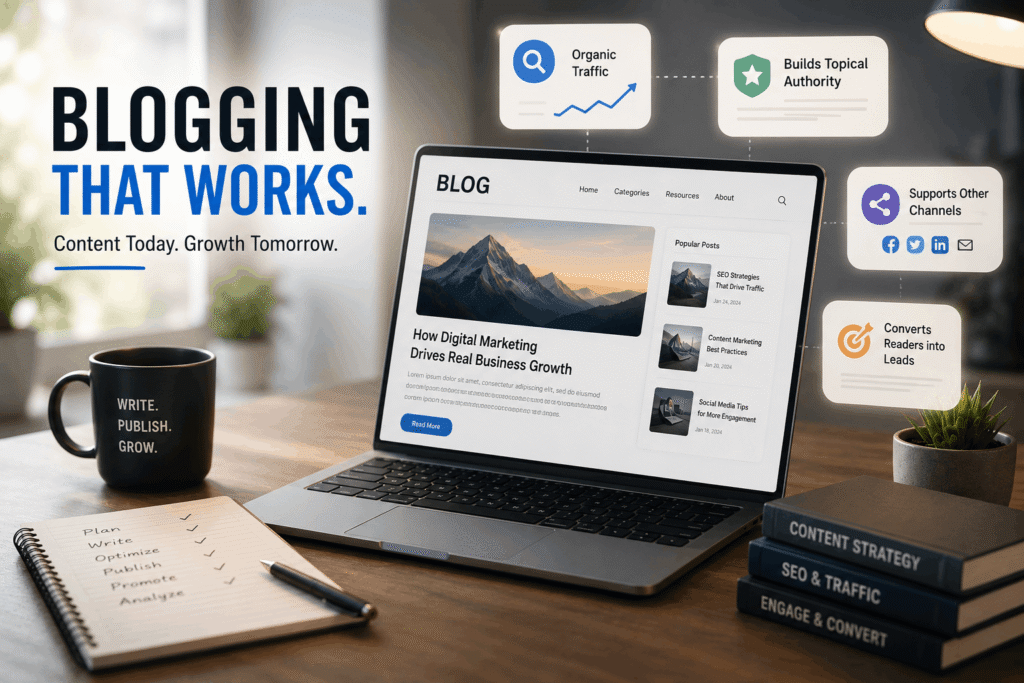
A blog isn’t just “content for content’s sake.” When it’s built with strategy, it does several specific jobs simultaneously:
Drives organic search traffic. Every blog post is a new page that can rank on Google. More well-optimized posts mean more entry points for search traffic — without paying per click.
Builds topical authority. Google rewards websites that cover a subject deeply. A site with 40 focused blog posts on digital marketing signals far more expertise than one with five generic articles.
Supports other channels. Blog content feeds social media, email newsletters, and even paid ads. One solid post can power a month of content across multiple platforms.
Converts readers into leads. A well-placed call-to-action inside a blog post — linking to a service, a free audit, or a contact form — turns passive readers into active prospects.
Why Most Business Blogs Fail (And How to Avoid It)
The failure pattern is almost always the same. Random topics. Inconsistent publishing. No clear audience. No internal links. No CTA.
Here’s what actually works instead:
Write for a Specific Reader, Not Everyone
The biggest mistake is writing for “anyone who might be interested.” A blog post that tries to appeal to everyone usually connects with no one.
Pick one type of reader — a startup founder trying to figure out marketing, a freelancer building their first client base, a small business owner comparing agency options — and write specifically for them.
Solve One Problem Per Post
Each blog post should answer one specific question well, not cover a topic broadly. “Digital marketing for small businesses” is too vague. “How small businesses in Delhi can use SEO without an agency” is specific, searchable, and useful.
Publish Consistently, Even If Infrequently
Three posts per week that drop to zero after a month is worse than one post per week maintained consistently for a year. Google notices publishing patterns. So do readers.
Use Internal Links on Every Post
Every blog post should link to at least 2 to 3 other relevant pages on your site — other blog posts, service pages, or your contact page. This builds site structure, keeps readers engaged longer, and distributes SEO authority across your pages. If you want to understand how this fits into the broader picture of choosing the right digital marketing strategy, our agency selection guide covers the strategic side in detail.
Types of Blog Posts That Perform Best in Digital Marketing
Not all blog content ranks or converts equally. These formats consistently outperform others:
| Blog Format | Best For | Example |
|---|---|---|
| How-to guides | Organic search + featured snippets | “How to Set Up Google Analytics in 5 Steps” |
| Comparison posts | High-intent readers ready to decide | “SEO vs PPC: Which Should You Choose First” |
| Listicles | Skimmable, shareable content | “7 Free Tools Every Small Business Should Use” |
| Explainers / Definitions | AEO and AI Overview targeting | “What Is a Conversion Rate and Why Does It Matter” |
| Case studies | Building trust and authority | “How We Grew a Local Brand’s Traffic by 3x in 4 Months” |
How Blogging Fits Into the Broader Digital Marketing Mix
Blogging alone isn’t a complete strategy. It works best when it’s connected to other channels.
SEO + Blogging: Your blog posts target specific search queries. SEO ensures those posts are structured, linked, and technically sound enough to rank. One without the other underperforms.
Social Media + Blogging: Blog posts give you something real to share. Instead of posting filler content daily, each post becomes a week’s worth of social material — quotes, breakdowns, carousels based on the original piece.
Email Marketing + Blogging: A weekly or monthly email that shares your latest post keeps your audience connected without requiring them to check your site regularly.
Paid Ads + Blogging: Blog posts make excellent landing pages for “warm” traffic — people who’ve clicked an ad but aren’t ready to buy. A useful article builds trust before a conversion ask.
According to HubSpot’s annual State of Marketing report, businesses that blog consistently generate significantly more inbound leads than those that don’t — a pattern that has held steady even as new channels like video and social have grown.
Blogging for DA/PA Growth
If you’re trying to build your site’s domain authority, blogging is one of the most reliable methods available. Each new, well-researched post:
- Creates more pages that can attract backlinks naturally
- Increases dwell time (how long visitors stay on your site)
- Reduces bounce rate when internal linking is done well
- Signals to Google that the site is active and regularly updated
If you’re also building a digital marketing portfolio as an individual, a personal blog with real published posts is one of the strongest proof-of-work assets you can show a potential employer or client.
Final Thoughts
Blogging isn’t a shortcut. It doesn’t produce instant results. But over six to twelve months of consistent, strategic posting, it becomes one of the most cost-effective traffic and authority channels available.
Start with your audience. Pick specific topics. Publish consistently. Link internally. Every other tactic builds on top of this foundation.

Frequently Asked Questions
Blogging drives organic search traffic, builds topical authority, supports other channels like social media and email, and converts readers into leads through well-placed calls to action inside the content.
Consistency matters more than frequency. One well-written post per week maintained for several months outperforms three posts per week that stop after a month. Google rewards reliable publishing patterns over time.
Most blog posts take 3 to 6 months to rank meaningfully, depending on competition, domain authority, and how well the post is optimized. Lower-competition keywords can show movement in as little as 4 to 8 weeks.
A strong SEO blog post targets one specific keyword, answers the reader's question thoroughly, uses clear headings, includes internal and external links, and has a meta description that accurately reflects the content.
Yes. Consistent blogging creates more pages that can attract backlinks, increases time-on-site when internal linking is strong, and signals to Google that the site is active — all of which contribute to domain authority growth over time.
Want to see how DigiSunami uses content strategy to drive real results for businesses? Explore our approach or get in touch for a straightforward conversation about your goals.
Keep Exploring with Digisunami
Career Guide • India • 2026 Blogging in Digital Marketing: Why It Still Works and How to Do It Right Author: Shivam
Marketing Guide • India • 2026 Performance Marketing vs Digital Marketing: What’s Actually Different Author: Shivam | 8 min read | July
Career Guide • India • 2026 Digital Marketing Career Path in 2026: A Realistic Roadmap (No Fluff) Author: Shivam | 9 min
Income Guide • India • 2026 How to Earn Money from Digital Marketing in 2026 (Real Ways That Work) Author: Shivam |