Performance Marketing vs Digital Marketing: What's Actually Different
Author: Shivam | 8 min read | July 10, 2026
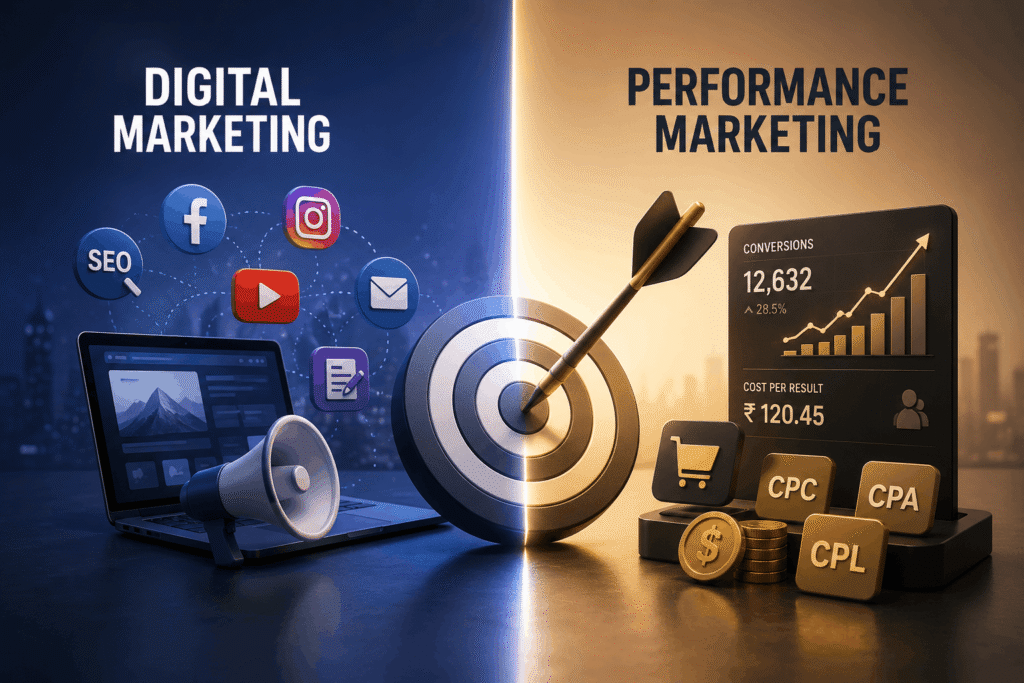
Quick Answer: Digital marketing is the broad category — it includes everything done online to promote a brand. Performance marketing is a specific subset where you only pay when a measurable result happens, like a click, lead, or sale. Every performance marketing campaign is digital marketing, but not every digital marketing effort is performance marketing.
These two terms get used interchangeably all the time, even by people who work in marketing. That confusion leads to real problems: businesses hiring for the wrong role, agencies pitching the wrong service, and marketers applying for jobs they don’t actually understand.
Let’s clear this up properly.
What Is Digital Marketing (The Full Picture)
Digital marketing is an umbrella term. It covers every marketing activity that happens through a digital channel — search engines, social media, email, websites, apps, and beyond.
Under this umbrella, you’ll find:
- SEO — getting organic search traffic without paying per click
- Content marketing — blog posts, videos, podcasts that attract and educate
- Social media marketing — building presence and community on platforms
- Email marketing — nurturing leads and customers through email sequences
- Paid advertising — Google Ads, Meta Ads, YouTube Ads
- Performance marketing — a specific paid approach (more on this below)
The goal of digital marketing in general is broad — awareness, engagement, consideration, and eventually conversion. Not every effort has a direct, measurable return tied to it.
What Is Performance Marketing (The Specific Thing)
Performance marketing is a results-first approach to paid advertising. You set a specific action you want — a click, a form submission, a purchase, an app download — and you pay only when that action happens.
The defining characteristics:
- Every rupee spent is tied to a trackable outcome
- Campaigns are optimized in real time based on data
- Payment models include CPC (cost per click), CPL (cost per lead), CPA (cost per acquisition)
- ROI is measurable, not estimated
Performance marketing typically includes Google Ads, Meta Ads, affiliate marketing, and programmatic advertising when run with conversion-focused objectives.
Side-by-Side Comparison
| Factor | Digital Marketing | Performance Marketing |
|---|---|---|
| Scope | Broad — all online channels | Narrow — paid, results-based only |
| Goal | Awareness to conversion | Direct, measurable conversion |
| Payment model | Varies (retainer, project-based) | Pay-per-result (CPC, CPL, CPA) |
| Timeline | Short and long term | Primarily short to medium term |
| Measurability | Varies by channel | High — every action tracked |
| Risk | Spread across channels | Budget risk if targeting is off |
| Best for | Brand building + growth | Immediate leads or sales |
The Most Common Misconception
“Performance marketing is better because it’s measurable.”
This is a misunderstanding that leads businesses to underinvest in brand building. Performance marketing is excellent at capturing demand — people who are already looking for what you offer. But it struggles to create demand from people who don’t know you exist yet.
Digital marketing in its broader sense — content, SEO, social — builds the awareness and trust that makes performance campaigns more efficient over time. A brand with strong organic presence converts paid traffic at a higher rate than a brand with zero recognition.
The two are not competitors. They are different tools that work better together.
Which One Does Your Business Actually Need Right Now
Choose performance marketing first if:
- You need leads or sales quickly
- You have a clear, specific conversion goal
- You have budget to test and optimize campaigns
- Your product or service has proven demand
Choose broader digital marketing first if:
- You are a new brand with low awareness
- Your product needs education before purchase
- You are building long-term organic traffic
- Budget does not allow for ongoing ad spend
Most growing businesses eventually need both. The typical path is starting with performance marketing for immediate revenue, while building organic presence through SEO and content in parallel. If you are at the stage of figuring out what your digital marketing budget should actually cover, our guide on digital marketing costs for small businesses breaks down realistic numbers for both approaches.
Career Perspective: Which Path Pays More
If you are considering this from a career angle, the distinction matters practically.
A digital marketing generalist role typically involves managing multiple channels — content, social, email, basic SEO. Broader skill set, lower salary ceiling early on.
A performance marketing specialist focuses specifically on paid channels — Google Ads, Meta Ads, programmatic — with heavy emphasis on data, attribution, and optimization. It tends to pay more at specialist level because the accountability is direct — you are responsible for ad spend ROI.
If you are mapping your digital marketing career path, understanding this distinction early helps you pick a specialization that matches both your strengths and income goals.
According to Google’s performance marketing guidance, campaigns that combine audience signals with clear conversion goals consistently outperform those optimized for clicks alone — which is why understanding the difference between reach and result matters even within performance marketing itself.
Final Thoughts
Performance marketing and digital marketing are not rivals. Performance marketing is a specific, measurable approach that lives inside the broader digital marketing world.
Businesses that understand the difference make smarter hiring decisions, set more realistic campaign expectations, and allocate budgets more effectively.
If you are building skills in this area, our breakdown of how to earn money from digital marketing covers which specializations pay the most and why.

Frequently Asked Questions
No. Digital marketing is the broader category that includes all online marketing activities. Performance marketing is a specific subset focused on paid campaigns where you pay only when a defined action occurs, like a click, lead, or sale.
Common examples include Google Ads campaigns optimized for conversions, Meta Ads with lead generation objectives, affiliate marketing programs, and programmatic advertising with CPA or CPL payment models.
Performance marketing specialists tend to earn more at the mid to senior level because they are directly accountable for measurable ad spend results. Digital marketing generalists often have a broader skill set but a lower salary ceiling early in their career.
Yes, but it requires a clear conversion goal and enough budget to test and optimize campaigns. Without sufficient budget or a well-defined target audience, small businesses often see better early returns from SEO and content before investing in paid performance channels.
Learning general digital marketing first gives you the context to understand how paid channels fit into a broader strategy. Most performance marketing specialists develop stronger skills when they understand SEO, content, and the full funnel before specializing in paid campaigns.
Keep Exploring with Digisunami
Marketing Guide • India • 2026 Performance Marketing vs Digital Marketing: What’s Actually Different Author: Shivam | 8 min read | July
Career Guide • India • 2026 Digital Marketing Career Path in 2026: A Realistic Roadmap (No Fluff) Author: Shivam | 9 min
Income Guide • India • 2026 How to Earn Money from Digital Marketing in 2026 (Real Ways That Work) Author: Shivam |
Income Guide • India • 2026 Freelance Digital Marketing Salary: What People Actually Earn in 2026 Author: Shivam | 8 min read